Introduction
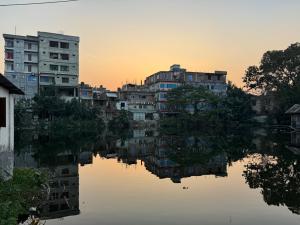
Tarabo has grown quickly into an industrial town, and its 150,709 residents rely largely on on-site sanitation in an area prone to waterlogging, with the Shitalakhya River along its western edge. Faecal sludge that is not safely contained, emptied and treated ends up in drains, wetlands and the river, which also serves as a vital waterway for the town. Tarabo Pourashava covers 24.6 square kilometres and nine wards in Rupganj Upazila, Narayanganj district, Dhaka division.
Project info
- Client: CWIS Technical Assistance Hub for South Asia (TA Hub), managed by DevConsultants Limited
- Funder / programme: Gates Foundation; Bangladesh Municipal Water Supply and Sanitation Project (BMWSSP) 30 Towns programme
- Period: Feb 2022 – May 2022
- Location: Tarabo Municipality, Narayanganj, Bangladesh
Scope
BMWSSP is aligned with the World Bank’s urban sector investment strategy. It aims to reduce the impacts of climate change while improving access to inclusive sanitation and employment in around 30 towns across Bangladesh, prioritising marginalised communities, women and people with disabilities.
While the wider programme helps municipalities improve service delivery, this assignment focused on upgrading sanitation services across the whole value chain in Tarabo, through a citywide inclusive sanitation (CWIS) plan.
Did You Know?
- Tarabo is renowned for its numerous wetlands.
- Tarabo has become an industrial hub with more than 300 medium and large industries, making it a centre of Bangladesh’s textile industry.
Services Delivered
Data Cleaning and Evaluation
We cleaned and evaluated the spatial and non-spatial data to check its accuracy and give a sound basis for the analysis that followed.
Spatial Analysis Across the Value Chain
We used spatial analysis across the sanitation value chain to identify where technology improvements would raise operational efficiency.
Regulatory Framework Development
We outlined a regulatory framework with monitoring indicators to set service standards and allow regular performance assessment.
Investment Estimates
We prepared investment estimates so that funds for sanitation could be allocated where they have the most effect.
Deliverables
Deliverables included presentations and reports on the outcomes, the CWIS plan, and insights gathered during the preparatory phases, presented at a workshop with local stakeholders.
Implementation Strategy
We formulated an implementation strategy to guide the roll-out of sanitation interventions based on the project’s findings.
Results
- A CWIS plan for Tarabo Municipality covering all nine wards.
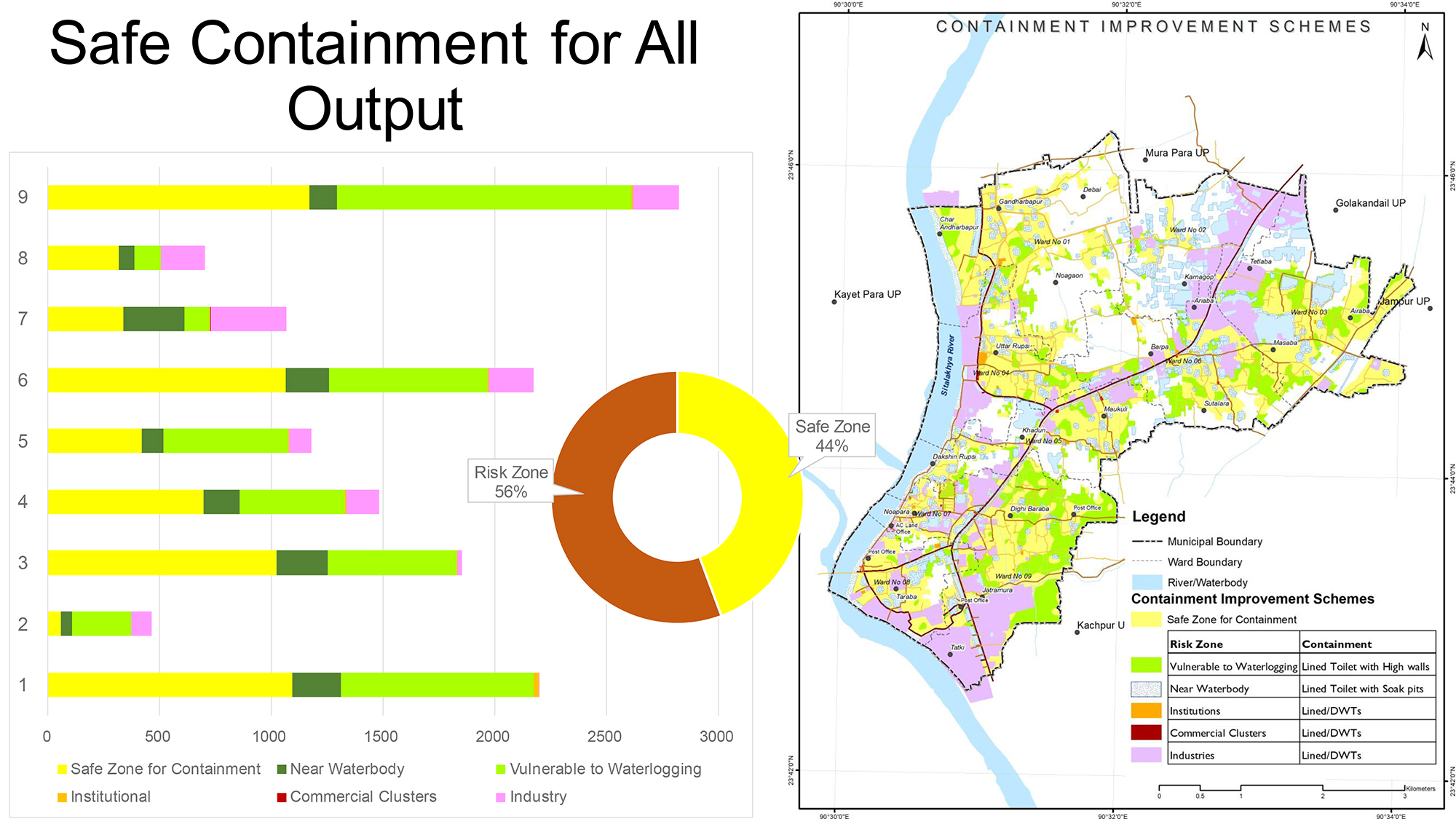
- Risk-based containment improvements, including lined containment with high walls and lined decentralised wastewater treatment systems (DEWATS).
- Investment estimates and an implementation strategy.
- A regulatory outline with monitoring indicators, and a business plan covering tariffs and financial sustainability.
Work Illustration
We proposed several containment strategies for Tarabo Municipality, chosen according to the level and type of risk. Risks were ranked by waterlogging, proximity to water bodies, institutions, commercial clusters and industries, with industries the lowest priority. On this basis we recommended containment improvements including lined containment with high walls and lined decentralised wastewater treatment systems (DEWATS).